What Is Network Infrastructure?
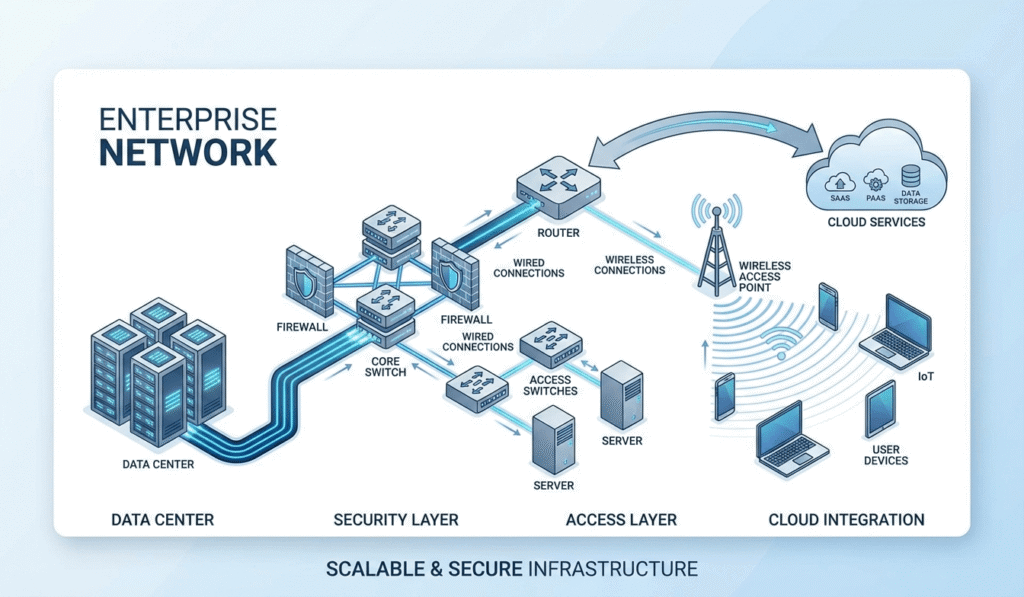
Network infrastructure refers to the integrated set of hardware and software components that enable modern computer networks to function. Organizations rely on network infrastructure and the connectivity it delivers to support communication among users, applications, and devices—forming the foundation of most contemporary business operations.
To maintain reliable network availability, many enterprises incorporate network infrastructure management into their strategic planning. This typically involves network monitoring, routine maintenance, management tools, and security solutions designed to optimize performance and ensure stability.
Because of its central role in essential business activities, network infrastructure has become a key driver of digital transformation. As a result, the global enterprise network infrastructure market continues to expand. Many organizations view this growth as an opportunity to adopt emerging technologies such as artificial intelligence (AI) and cloud computing to enhance efficiency and scalability.
Valued at nearly USD 60 billion just two years ago, the global network infrastructure market is projected to grow at a compound annual growth rate (CAGR) of 4.9% over the next five years.
Features and Components of Network Infrastructure
Modern networks operate through an integrated mix of hardware and software components, along with established practices, processes, and systems. These elements work together to ensure reliable connectivity, efficient data transmission, and secure network operations.
Network infrastructure typically includes widely used components and services such as networking devices, management tools, and supporting systems. Each of these plays a specific role in enabling the network to function effectively, supporting communication between users, applications, and connected devices across the organization.
Nodes and IP Addresses
A node is any point within a network that is connected to a device—such as a computer, printer, or modem—and is capable of sending, receiving, creating, or storing data. For network infrastructure to operate correctly, networking devices including computers, routers, and switches must be able to identify, process, and transmit information efficiently. To enable this, each node is assigned a unique identifier known as an IP address and is granted authorized access to the network.
An Internet Protocol (IP) address is a numerical label assigned to a node connected to a computer network. This address uniquely identifies both the device and the network to which it belongs, as well as its specific location within that network. When data is transmitted from one device to another, the IP addresses of both the sender and the receiver are included in the data packets. Routers and switches use these IP addresses to direct data across the network and ensure it reaches the correct destination.
Routers and Switches
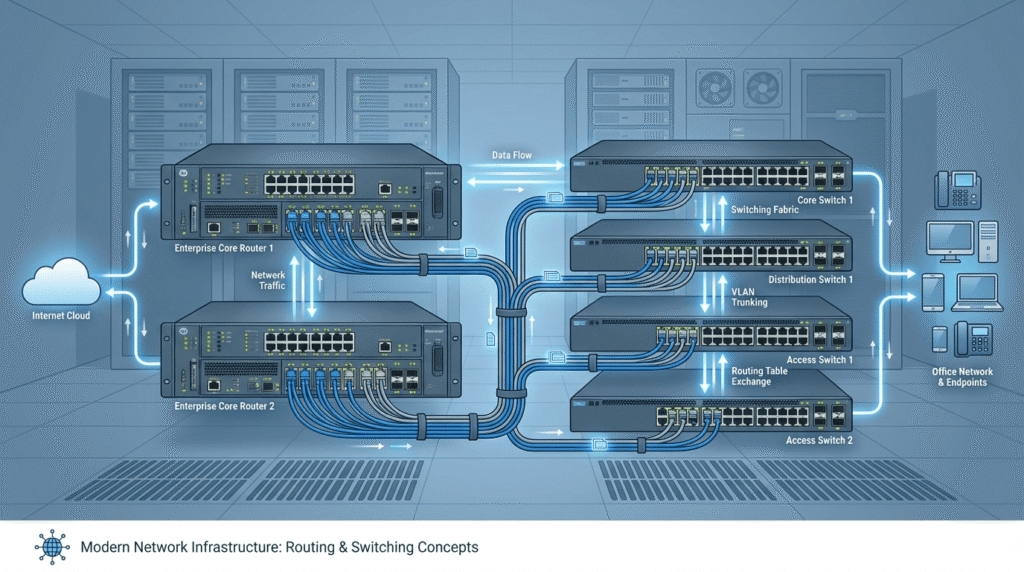
A router is a networking device that forwards data packets—small, formatted units of information—between different networks. Routers examine incoming data and determine the most efficient path for transmission by using routing tables and advanced routing algorithms, ensuring that packets are delivered accurately to their destination nodes.
A switch is a device used to connect multiple devices within a network and manage communication between nodes. Its primary function is to ensure that data packets are delivered to the correct destination device. Unlike routers, which operate between separate networks, switches handle data transmission within the same network by directing traffic between connected nodes.
Wireless Access Points (WAP)
A wireless access point (WAP) is a networking component that allows Wi‑Fi‑enabled devices such as smartphones, tablets, and laptops to connect to a network. WAPs function as an intermediary between a wired network—where nodes are connected using physical cables such as Ethernet—and a wireless network that relies on radio signals, including Wi‑Fi and cellular technologies.
Wireless access points play a vital role in network infrastructure by bridging wired and wireless environments. They enable seamless connectivity for users, applications, and devices that require flexible network access, ensuring consistent internet availability and efficient data communication across the network.
Software‑Defined Networking (SDN)
Software‑defined networking (SDN) is a software‑driven approach to network infrastructure that separates network control from physical hardware and relies on application programming interfaces (APIs) to manage network operations. SDN enables organizations to use a centralized platform to communicate with network devices and intelligently direct network traffic, making it well suited for modern, application‑centric business environments.
As adoption continues to increase, SDN has gained significant market traction. The global SDN market reached a valuation of approximately USD 28.2 billion last year and is projected to grow at a compound annual growth rate (CAGR) of 17% over the next seven years.
Within network management, a centralized model known as software‑defined wide area networking (SD‑WAN) provides administrators with a comprehensive view of the entire network. This approach enables the collection of routing data, optimization of network resources, improved performance, task automation, enhanced load balancing, and reduced latency and service disruptions. In addition, SD‑WAN solutions strengthen network infrastructure security by integrating features such as firewalls and intrusion detection and prevention systems (IDS/IPS).
Wired vs. Wireless Networks
Beyond their architectural differences, wired and wireless networks serve distinct roles within modern network infrastructure. Wired networks—where data is transmitted between nodes, switches, and routers through physical cables—are essential for handling workloads that require high bandwidth, stable connectivity, and strong security. These networks are commonly used for demanding tasks such as large‑scale data transfers and enterprise‑level applications.
Wireless networks, by contrast, transmit data using radio waves and are better suited to environments where flexibility and mobility are more important than maximum bandwidth or security. Home internet connections and Internet of Things (IoT) devices—ranging from smart appliances and televisions to autonomous vehicles—often rely on wireless networking technologies. Although wireless networks are generally less secure than wired alternatives, each new generation offers improved reliability and stronger security features. For instance, modern high‑speed 5G networks incorporate more advanced encryption and authentication standards compared to earlier technologies such as 4G.
Enterprise Benefits of Strong Network Infrastructure
Digital technologies play a central role in most modern business processes, making investment in a robust network infrastructure essential for organizations. Well‑designed networks form the foundation for new technological solutions, enhance productivity, and enable businesses to collect, process, and analyze large volumes of data more efficiently.
By contrast, weak or poorly designed network infrastructure can lead to a range of challenges, including security vulnerabilities, slow data transfer speeds, disruptions to employee and user workflows, degraded application performance, and increased operational inefficiencies.
Organizations increasingly rely on network infrastructure to support critical capabilities such as remote work and cloud computing, both of which are now fundamental to business success. Strong, well‑architected IT infrastructures enable seamless, real‑time collaboration, reliable internet access, and reduced interruptions to daily operations.
Some of the most significant benefits of building and maintaining a strong network infrastructure include the following:
Increased Scalability
Modern network infrastructures are designed to scale according to the specific needs of a business or industry. Networks built with current technologies can be expanded or reduced easily, including key resources such as bandwidth, storage, and computing power. As workloads and organizational requirements evolve, a well‑designed network can grow or contract accordingly.
Improved Resilience
Contemporary network architectures incorporate built‑in load‑balancing mechanisms that distribute traffic efficiently, even during peak demand. When individual components fail, workloads can be reallocated quickly to maintain service continuity and minimize downtime.
Strong Security
As cyber threats continue to evolve, network security remains a top priority for organizations. Modern network infrastructure helps protect against data breaches, malware, cyberattacks, and unauthorized access to sensitive information. Security measures such as firewalls, virtual private networks (VPNs), access controls, network segmentation, and regular software updates work together to create a comprehensive and effective defense strategy.
Strong Return on Investment (ROI)
Building a modern, scalable network infrastructure typically requires a relatively low initial investment and can be expanded gradually as business needs grow. This flexible and cost‑effective approach allows organizations of all sizes to invest at their own pace, evaluate resource usage, and adjust services as requirements change.
Better User Experience
A modern network infrastructure that leverages up‑to‑date digital technologies significantly improves the user experience for employees and customers alike. Reliable, fast, and seamless connectivity supports efficient business operations, enhances productivity, and contributes to higher levels of customer satisfaction.

Modern Network Infrastructure Use Cases
As modern network infrastructure continues to evolve in response to emerging technologies and shifting business requirements, its range of use cases continues to expand. Organizations across industries rely on advanced network infrastructures to support critical operations, improve efficiency, and enable digital innovation.
Today, modern network infrastructure underpins a wide variety of applications and services, from cloud computing and remote work to data‑intensive workloads and emerging technologies. Below are some of the most common and impactful use cases of modern network infrastructure in enterprise environments.
Personal Area Networks (PANs)
Personal Area Networks (PANs) are simple, reliable network types designed to connect devices that are located only a few feet apart. These networks typically rely on short‑range communication technologies, such as infrared or Bluetooth, to enable direct device‑to‑device connectivity.
Bluetooth is one of the most common examples of a PAN, widely used to connect personal devices such as smartphones, laptops, speakers, headphones, and televisions within homes or small personal environments.
PANs are generally wireless and support connectivity across a very limited physical area. In some cases, they can also provide internet access by forming small, temporary networks that are restricted to authenticated devices. A common example is using a smartphone to create an internet hotspot in public spaces such as cafés, allowing nearby devices to connect securely.
Although PANs are often considered relatively secure due to their short operational range, security best practices should still be followed. The use of strong passwords, authentication mechanisms, and encryption is recommended to prevent unauthorized access and protect data transmitted over the network.
Local Area Networks (LANs)
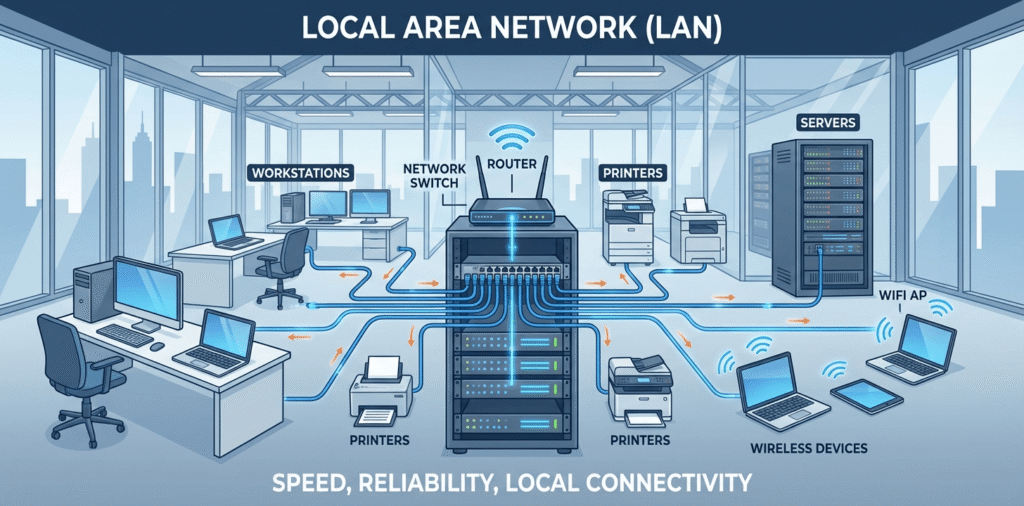
Local Area Networks (LANs) are network systems designed to connect computers and other devices within a single, limited physical location. LANs can operate using both wired and wireless connections, and their effective range depends on the network topology, including the number of connected devices and their physical proximity to one another.
Unlike Personal Area Networks (PANs), which typically operate over only a few feet, LANs generally span larger distances. Their coverage often starts at several feet and can extend to hundreds of feet, particularly in larger office environments or commercial buildings.
LANs are widely deployed in business and organizational settings, where multiple users and systems need to share data, applications, and network resources within a confined geographical area. When properly designed and configured, LANs can offer a high level of performance and security.
However, maintaining LAN security requires active management and protective measures. Without safeguards such as firewalls, access controls, network segmentation, and continuous monitoring, LAN‑connected nodes may become vulnerable to cyberattacks, data breaches, and other security threats.
Wide Area Networks (WANs)
Wide Area Networks (WANs) are large‑scale computer networks typically used by enterprises to connect offices, data centers, and users across multiple physical locations. WANs enable communication and data exchange over long distances, often spanning cities, countries, or even continents.
The most widely recognized example of a WAN is the internet itself—a global network that connects billions of users and devices across geographically dispersed locations. Another common example is the financial network infrastructure that enables automated teller machine (ATM) services for bank customers in different cities and countries.
WANs extend far beyond the range of Personal Area Networks (PANs) and Local Area Networks (LANs). Although they are technically composed of multiple interconnected PANs and LANs, their scale and complexity require different architectural and security approaches.
To protect data transmitted across vast distances, WANs rely on a combination of traditional and advanced security technologies. In addition to firewalls and encryption mechanisms, many WANs use technologies such as Multiprotocol Label Switching (MPLS) to enhance traffic management, improve performance, and help ensure the secure transmission of data across regions and around the globe.
Metropolitan Area Networks (MANs)
Metropolitan Area Networks (MANs) are composed of interconnected Local Area Networks (LANs) and Personal Area Networks (PANs) distributed across a defined geographical area. MANs are commonly used to link local businesses, multiple buildings within a university campus, government facilities, and other networks that are physically separate but geographically close.
Similar to other network types, MANs rely on a combination of wired and wireless connectivity technologies. These typically include fiber‑optic connections, Ethernet, and modern wireless solutions such as 5G, enabling high‑speed and reliable communication across the metropolitan area.
MANs are smaller in scale than Wide Area Networks (WANs) and are generally more efficient, as they cover a more limited physical region. Although MANs consist of multiple interconnected networks, their administration, management, and security are usually controlled by a single organization, allowing for centralized oversight and consistent policy enforcement.
Cloud Networks
Cloud networks are virtual network infrastructures composed of servers, virtual machines (VMs), applications, and other interconnected systems. These networks are provided and managed by cloud service providers (CSPs), which specialize in delivering cloud computing solutions through highly scalable and distributed network architectures.
Unlike traditional network types, cloud networks are entirely virtual. They are hosted and operated on infrastructure owned and maintained by the CSP, rather than by the end user or organization. This model removes the need for companies to build and manage physical network hardware while still enabling access to powerful networking and computing capabilities.
CSPs supply the required software platforms and virtualized hardware resources that allow organizations to deploy, operate, and scale a wide range of services in the cloud. One of the key advantages of cloud networks is their ability to scale dynamically, enabling resources such as computing power, storage, and bandwidth to be adjusted on demand based on workload requirements.
Cloud adoption has grown rapidly in recent years, with more than 90% of organizations now using cloud services in some capacity. To access cloud network infrastructure and its associated benefits, organizations simply need a device with an internet connection, making cloud networks a foundational component of modern digital transformation, remote work, and cloud‑based application delivery.
Why Network Infrastructure Matters?
A well‑designed network infrastructure plays a critical role in enabling secure communication, scalable operations, and reliable connectivity across modern organizations. From local and wide area networks to cloud‑based environments, understanding how different network types and components work together helps businesses make informed decisions, improve performance, and support long‑term digital growth.